


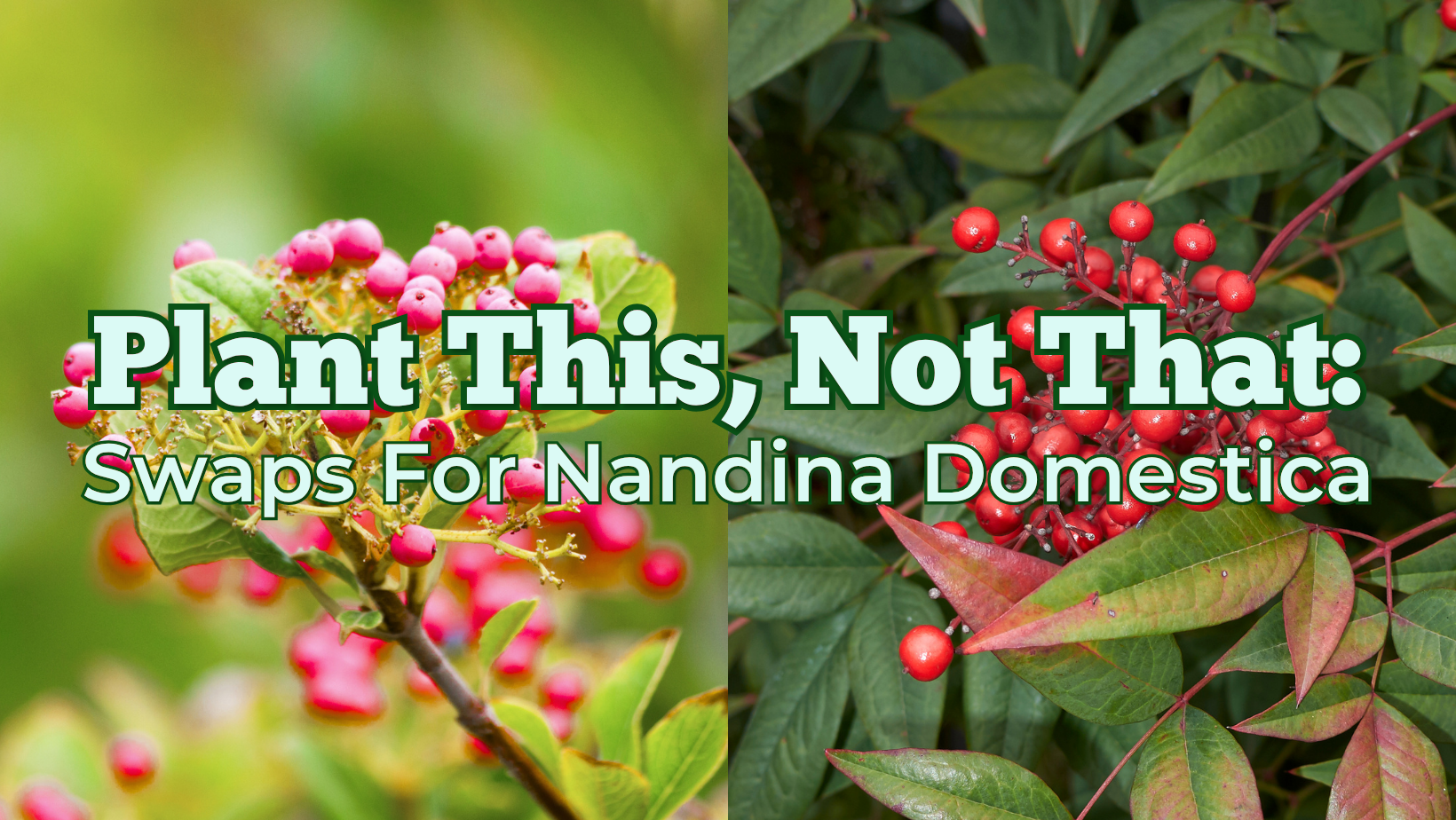
For decades, Nandina domestica (Heavenly Bamboo) has been a go-to shrub for foundation plantings in landscapes across Maryland. It’s easy to see the appeal: this evergreen holds its structure through winter, its foliage turns shades of red, orange, and purple in the cold months, and it produces clusters of bright red berries that stick around when little else in the garden is blooming. It tolerates shade, is drought-tolerant once established, and deer tend to leave it alone. For a plant that asks so little and gives so much visual payoff, it’s no wonder Nandina has been a favorite for generations.
The trouble is what happens after those berries form. Birds eat them and carry the seeds well beyond the garden bed, dropping them into forests, stream banks, and natural areas where Nandina has no natural checks on its growth. Left alone, it spreads into dense thickets that crowd out native understory plants and reduce the diversity on which local wildlife depends. There’s an added twist: Nandina berries contain compounds that convert to cyanide, and when birds like cedar waxwings gorge on a large quantity, especially berries that have been through a hard frost, it can be fatal.
Maryland has been tightening the rules around Nandina for years. It was first added to the state’s Tier 2 invasive plant list in 2017, and on January 15, 2026, MDA announced Nandina domestica as one of 13 species now prohibited for sale in the state. The good news is that none of what made Nandina appealing has to disappear from your garden. There are native and non-invasive shrubs that match or beat it on color, berries, form, and toughness. Here’s what to plant instead.

Hearts A Bustin’ Euonymus (American Strawberry Bush)
This native shrub earns its nickname honestly. In fall, its seed capsules split open into little pink-red pods that reveal bright orange-red seeds inside, looking exactly like tiny bursting hearts. It’s a showier, more textural take on the “berries in fall” quality that made Nandina a favorite, and it comes with its own soft reddish-purple foliage. It handles part shade the same way Nandina does, so it slots into the same spots in the landscape without missing a beat.
Brilliant Red Chokeberry (Aronia arbutifolia ‘Brilliantissima’)
If it’s fall color you’re chasing, this native chokeberry delivers some of the most vivid red foliage of any shrub on this list, easily standing in for Nandina’s autumn show. It carries bright red berries that persist through winter and get eaten by birds without the toxicity concerns Nandina brings. The best part is, these berries aren’t just for birds; they’re edible to humans too! Chokeberries can be eaten raw, used to make jams and jellies, or even as a base for wine! As a bonus, it produces clusters of white flowers in spring.


Winterthur Viburnum (Viburnum nudum ‘Winterthur’)
This native viburnum trades Nandina’s single-note red berries for a full color progression: clusters of white flowers in spring give way to berries that shift from pink to blue to nearly black as the season goes on, often with several colors on the shrub at once. Its fall foliage turns a deep burgundy-red that rivals Nandina’s best display, and the multi-stage berry show adds even more seasonal interest.
Mountain Fire Pieris (Pieris japonica ‘Mountain Fire’)
For gardeners who loved Nandina’s evergreen structure and reddish new growth, this pieris is the closest match on the list. Its new leaves emerge a fiery, glossy red before settling into deep green, and in spring it sends out cascading clusters of small white, bell-shaped flowers. It keeps the same tidy, rounded evergreen habit Nandina is known for, so it works well as a foundation plant, or anywhere you need year-round structure.


Linebacker Distylium (‘PIIDIST-II’ Linebacker)
Distylium has become a favorite substitute for classic evergreens, and it’s easy to see why. Linebacker holds a neat, upright shape similar to Nandina’s, stays evergreen through winter, and produces small, spidery red flowers in late winter when little else is blooming. It’s remarkably adaptable, handling both wet and dry sites, tolerating partial shade, and deer generally pass it by, all qualities that made Nandina low-maintenance in the first place.
Bonus Plant: Summer Wine Ninebark (Physocarpus opulifolius ‘Seward’)
This native ninebark retains Nandina’s seasonal foliage color and extends it throughout the growing season. Its deep wine-red leaves hold that color from spring through fall rather than turning only in autumn, so it delivers even more color than Nandina over the course of the year. Clusters of white-and-pink flowers appear along the branches in late spring, and its peeling, exfoliating bark adds interest once the leaves drop. It’s also a strong pollinator plant, tolerant of a wide range of soil and light conditions.

Making the Swap
Every plant on this list gives you what drew you to Nandina in the first place, whether that’s fall color, cool-season berries, evergreen structure, or cascading spring flowers, without sending seeds into the woods behind your house. With Nandina now on Maryland’s prohibited-for-sale list, this is a good season to get ahead of the phase-out and start replacing it with something that will continue to do its job in the landscape for decades to come.
Leave a Comment
You must be logged in to post a comment.